
14453 Beach Blvd., Suite 100, Jacksonville, FL 32250 904-992-8900

Restorative & Specialty
Sleep apnea and TMJ disorder are different problems, but both come back to how your jaw and bite function while you sleep, eat, and speak.
At Azari & Zahedi Dentistry, we treat both with custom oral appliances, careful bite analysis, and a patient-first approach that aims to relieve symptoms without rushing to surgery. If snoring is keeping your partner awake, or if jaw pain and headaches have made daily life harder, we can help.
This page is divided into two parts so you can read the section that matters to you. Jump to Sleep Apnea | Jump to TMJ / TMD

Part 1 of 2
A condition that affects 13-17% of adult Americans, and one of the most common causes of daytime fatigue, high blood pressure, and disrupted sleep for both partners.
Obstructive Sleep Apnea occurs when the tongue is stuck against the back of the throat, blocking the upper airway and causing airflow to stop. Obstructive Sleep Apnea is a very common chronic disorder that may create respiratory or cardiovascular complications if left untreated.

Obstructive Sleep Apnea is very common and, if left untreated, can cause individuals to stop breathing during their sleep for a minute or more. Each time this happens, the brain wakes the person up momentarily to get them breathing again, which results in sleep being interrupted frequently and leaves the person tired throughout the day.
If your bed partner notices that you snore or gasp for air regularly while sleeping, you may have Obstructive Sleep Apnea (OSA). Not everyone who snores has OSA. However, everyone who has OSA does snore.
OSA is a condition in which people stop breathing for short periods, several times, if not hundreds of times, per night.
of all adult Americans are affected by sleep apnea.
Severe OSA can take a decade or more off a person's life.
Undetected sleep apnea is serious and can lead to obesity, diabetes, high blood pressure, heart attack, stroke, and even death.
If any of these sound familiar, it's worth a conversation:
OSA can only be properly diagnosed by a board-certified M.D. in sleep medicine. This is done either by spending a night in a sleep lab connected to wires and monitors, or by a home sleep test.
In our office, we have home sleep testing monitors you can wear to bed in your own home. When you bring the testing unit back, we upload the data to a board-certified sleep physician who diagnoses whether you have sleep apnea, determines how severe it is, and recommends treatment options: dental, medical, or surgical.

A snoring appliance is an oral appliance that resembles an athletic mouthpiece. Small and flexible, it has no moving parts, masks, hoses, or batteries. Generally made from sterile plastic, it's easy to clean with a regular toothbrush.
The appliance is custom-fit by a dentist in one simple, painless visit. It's fitted to your teeth to keep the upper and lower jaw in position when the jaw and throat muscles relax during sleep. The result: an open airway, restful sleep, and quiet nights for both you and your partner.
Part 2 of 2
Jaw pain, clicking, popping, headaches, and ear congestion: symptoms of a common but often misdiagnosed condition that's almost always treatable without surgery.
Do you experience a clicking or popping sound when opening or closing your mouth? Have you been suffering from headaches or migraines that no one seems to be able to help? Have you been taking pain medicine for years and would like to get off it? Do you feel clogging or congestion in one or both of your ears?
These are just a few of the many symptoms associated with TMD, or Temporomandibular Dysfunction, a common condition affecting the jaw joint, the Temporomandibular Joint (TMJ).
TMJ dysfunction, often referred to as TMD, is a disharmony between the way the jaw joint works in an unstrained position and the way the teeth and bite work during those movements. Possible causes include tooth loss, accidents like whiplash, mal-positioned or underdeveloped cranial or jawbones, and habits like clenching or teeth grinding. Many people go through life suffering from headaches and a variety of facial and neck pains without knowing the ultimate cause, which in many cases is TMJ disorder.
These are the two joints that connect the lower jaw to the temporal bone at the side of the head. If you place your fingers just in front of your ears and open your mouth, you can feel the joint on each side. Because these joints are flexible, the jaw can move smoothly up and down and side to side, enabling us to talk, chew, and yawn.
When the TMJ is not functioning normally and is not within its physiological limits, it creates a condition called TMD: a group of conditions resulting from not having normal function or comfortable positioning of the TMJ, presenting as a cycle of pain, muscle spasms, and jaw problems.
When teeth are missing, out of alignment, crowded, or misshapen, chewing and biting can't be balanced, so the TMJ and chewing muscles try to compensate, which produces symptoms that confirm the presence of TMD.
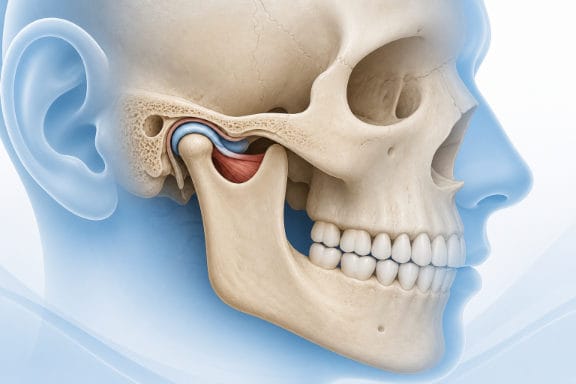
Temporomandibular Joint Disorder isn't just one disorder. It's a group of conditions, often painful, that affect the jaw joint and the muscles that control chewing. TMD falls into three main categories:
The most common form, discomfort or pain in the muscles that control jaw functions, plus the neck and shoulder muscles.
A dislocated or displaced disc, or injury to the condyle, the rounded part at the end of the jawbone.
Conditions like Osteoarthritis or Rheumatoid Arthritis affecting the jaw joint itself.
There are many causes for TMD, including:
When teeth are missing or out of alignment, the jaw shifts position and the muscles work harder to chew, swallow, and bite, eventually causing muscle spasms, tension, and pain. Muscle tension and a misplaced TMJ can pull the TMJ disc out of place, resulting in pain, clicking, and popping in the joint. If the disc stays displaced, the bones start rubbing against each other and damage develops, known as Osteoarthritis. Inflammation in other joints or bones may also involve the jaw bone and the TMJ, and damage may show on x-rays.
Good news: TMJ / TMD is treatable most of the time.
Simple cases of TMJ can be treated with anti-inflammatory medications and a hot, moist compress. Treatment for more complex cases usually consists of two phases.
Phase I
Phase I includes the fabrication of an orthotic, an acrylic device worn on the lower teeth 24 hours a day, designed to reposition the jaw to its correct neuromuscular position.
First we analyze the bite, identify which muscles are causing the pain, and locate the current position of the bone and disc. We do this with the help of advanced equipment:
Once the best, most comfortable position is determined, we place the orthotic on the lower teeth to keep the TMJ in that position. Orthotics are usually worn for 4-6 months, or until most symptoms are relieved. Symptoms gradually disappear until both doctor and patient are satisfied, concluding Phase I.

Phase II
After 4-6 months of relief, when the patient is no longer suffering from TMD symptoms, Phase II is considered. Phase II can include any of the following:
Wearing a removable orthotic full-time or part-time to maintain the corrected position.
Restoring missing teeth so the bite is balanced and the jaw doesn't have to compensate.
Braces or Invisalign to align teeth into the correct neuromuscular position.
Restore teeth with crowns and veneers to preserve the optimal bite achieved in Phase I.
Most of the time, any of the above can be considered and chosen depending on the patient's preferences and financial situation. If you are currently suffering from TMD, it's too early to think about Phase II. The priority is getting you out of pain first.
Bite splints, sometimes called bite plates, are effective in relieving TMD symptoms. A bite splint provides an acrylic platform to bite against, and some bite plates move the mandible to a new position.
Generally, splints are worn part-time. For most people, nighttime is the best time to wear them, protecting teeth from grinding and giving the jaw muscles a chance to rest.

A Note for Denture Patients
Many patients tell us that after they received dentures, they began experiencing pain in the jaw, headaches, ear problems, and other symptoms. Sometimes simply taking the dentures out provides relief.
If your dentures aren't made to the correct bite, or vertical dimension, they can cause exactly these symptoms. Sometimes a simple adjustment is all that's needed. Other times, a whole new set of dentures fabricated according to neuromuscular principles is the only way to fully resolve the headaches or jaw pain.
If you're a denture patient with persistent jaw or head symptoms, please tell us at your next visit. It's a fixable problem.
Call our office or request an appointment online - we'll help you understand the right full-arch option for your situation.
