
14453 Beach Blvd., Suite 100, Jacksonville, FL 32250 904-992-8900

Kids Dentistry
Azari & Zahedi Dentistry is here to serve you and your children by rendering high-quality dental care. No matter your child's age, we have the abilities and expertise to address their specific needs, from preventive care and a first dental visit through cavity treatment, restorations, and safe sedation when it is needed.
This page is organized in three parts so you can jump straight to what you are looking for: Preventive Care and First Visits, Cavity Treatment and Restorations, and Safe Sedation for Children.

Part 1 of 3
At Azari & Zahedi Dentistry, we are committed to providing our patients with the most current preventive measures available in dentistry.
Pit and fissure sealants and fluoride treatment are two proven steps that achieve this goal easily and effectively. Continuous care in our office entails Dr. Zahedi checking the integrity of sealants each time to ensure they are intact. Attention to detail is well worth it since permanent teeth are involved.
Besides professionally applied agents, we recommend solid oral hygiene practices and a healthy diet containing Xylitol that prevents cariogenic bacteria from activating and populating in the mouth. At Azari & Zahedi Dentistry, we tailor preventive-care pillars to your child's specific needs as a well-planned recipe for a happy smile.
As you prepare for your child's first dental visit, many questions can be associated with the trip. The good news is that dental appointments do not have to be complicated. We strive to make the first visit a fun one. The setting is warm and friendly, and the staff is highly inviting to make our patients and parents feel like they are in a dental home.
Of clear importance is to start the first dental appointment before any problem arises. We recommend your child see a pediatric dentist by age one or within six months of getting their first baby tooth.
Tooth decay can happen as soon as a tooth arrives in the mouth, and while prevention is so easy at this young age, the cure may not be. Early connection with a dentist helps children learn that dental visits are a normal part of life and helps curb dental apprehension before it even starts.

Baby's first visit will be short and sweet, usually less than 45 minutes in our office. The purpose of this visit is to counsel on oral hygiene and feeding practices and to set up a dental home for ongoing access to oral health care.
Before starting, we may ask questions about your child's current routine and then proceed with an examination. We usually perform exams in a lap-to-lap position that allows us to check the mouth, teeth, and hard-to-see areas. Your child gets to stay in your lap, facing you and holding your hands while we perform the exam.
A gentle cleaning and fluoride application is part of your baby's first visit at Azari & Zahedi Dentistry. While we make every effort for a visit to be comfortable and happy, some babies may cry during the dental exam. There is no need to worry. This is normal behavior for their age.
The American Academy of Pediatric Dentistry recommends using cavity-preventing fluoride toothpaste as soon as the first tooth appears. Use a rice-grain-sized smear of toothpaste for your baby or toddler, graduating to a pea-sized dollop by age 3. Good oral-hygiene practices start even before the first tooth arrives.
Although you are recommended to bring your child to the pediatric dentist around their first birthday, the typical age of a kid's first visit may be 2, 3, or 4, or even later. That is perfectly fine. We are ready to work with your child whenever you are ready to bring them in.
Toddlers have all their baby teeth by 2 1/2 to 3 years of age and start to form contact between their teeth, so this is a great time to instill good oral habits and make an adventure out of the first dental visit. We continually adapt to your child's age, personality, and developmental readiness as we embark on a dental health journey together.
Be confident that the visit will go well. Chances are that it will.

In most circumstances, you will find immediate help by calling our office. Expert care is available for conditions such as:
How long does it take to fix a chipped tooth? The answer may vary due to child age, degree of cooperation, and the extent of treatment needed. We offer various treatment options and accommodations to get your child fast relief.
As a parent, you want to ensure the best material goes into your children's mouths. According to the American Dental Association and the U.S. Food and Drug Administration, sealants are safe composite resin materials and BPA-free. Sealants act as a physical barrier to tooth decay and provide a high level of protection.
Sealing teeth can be done in a single dental visit and is entirely painless, thanks to the expertise of our pediatric dentist Dr. Marzieh Zahedi and our trained team. Aesthetically, dental sealant is white and blends well with tooth structure.
Reference: ADA evidence-based clinical practice guideline for pit-and-fissure sealants.

Fluoride plays a vital role in healthy tooth development and cavity prevention. It is a natural mineral found in soil, water, and food, and can be incorporated into teeth and bones as well.
Fluoride combats tooth decay in two ways:
Topical applications incorporate fluoride ions into the crystalline structure of enamel, making it more resistant to demineralization. The natural level of fluoride in human teeth wears away over time, so periodic applications continue to remineralize the enamel surface. Fluoride can be infused with toothpaste, mouthwash, and drinking water; individuals at risk of developing cavities can benefit from over-the-counter fluoride products and professional in-office applications.
Dr. Marzieh Zahedi's team uses fluoride varnish due to the research behind it and its superior performance. Varnish has an advantage over gels, foams, rinses, and pastes because of its ability to remain on the tooth surface for hours. Children can eat and drink right after application, and it has a good taste.

With Xylitol use, the quality of bacteria in the mouth changes over time, and fewer decay-causing bacteria survive on tooth surfaces.
The oral microbiome enters the body and influences overall wellness. The mouth is the gateway to the whole body. Bacteria that infiltrate the body through the mouth can cause problems here and there. Prebiotics help us fight these bacteria and restore healthy microflora.
Xylitol is a major prebiotic that inhibits the growth of cavity-causing bacteria (Streptococcus mutans), which cannot utilize Xylitol to grow. Xylitol is part of the daily diet and occurs naturally in many fruits and vegetables; eating blueberries is like eating Xylitol.
In many gums and mints, Xylitol makes oral care easy and convenient throughout the day. Tooth gel and mouthwashes with Xylitol create an excellent dental defense system. At Azari & Zahedi Dentistry, we recommend products with 100% Xylitol that are researched and have proven their efficacy.
These steps ensure you are taking care of your whole-body health by keeping your mouth clean and germ-free. That will be something worth smiling about.

Part 2 of 3
Early childhood caries is one of the most common childhood diseases. That means as much as you enjoy your child's precious smile, microorganisms are hard at work. Even with prevention and the elimination of risk factors, the condition may continue, and treatment becomes necessary.
As a parent, you look for the best therapeutic option, especially in the esthetic zone. You want durability and cost-effectiveness besides natural and beautiful-looking teeth. Here at Azari & Zahedi Dentistry, we offer specialized treatment to get that smile back.
A strip crown is a cosmetic alternative to placing crowns on primary incisors when enough tooth structure is left to support the filling. The success of the treatment depends on careful case selection and the expertise of your pediatric dentist. Dr. Zahedi can mix the art of aesthetics with skill and a love of smiles to give your child the best possible restoration.
The strip crown is a plastic tooth-like shell that we fill with white restorative material and fit over the damaged tooth. After light curing, we strip off the crown form, and a full-coverage bonded restoration is revealed.
This procedure is highly technique-sensitive and, like any other material, can fracture if the child grinds or is subject to trauma.

Replacing missing or damaged front teeth with a pediatric partial is a service we offer for comfort and convenience. Children are prone to lose teeth even early in life. Whether due to dental disease, a playground accident, or a bathtub fall, premature loss of teeth is an unavoidable part of childhood.
Some parents may be unsure how to approach replacing missing teeth at this stage, and knowing this option is available is comforting.
The process usually needs two visits to complete: first for the mold and fabrication, second for insertion. The pediatric partial is a fixed appliance, and children cannot remove it unless they apply excessive force. We monitor the area, and when it comes time for the near-eruption of permanent teeth, usually around age seven, we remove it.
Maintaining good oral hygiene and periodic visits to Azari & Zahedi Dentistry help with the longevity and esthetic of the appliance.

Zirconia crowns are an excellent fit for restoring molar teeth on select candidates. We also offer Zirconia crowns on the upper front teeth when there is insufficient tooth structure for bonding. The material is biocompatible and is the next generation in pediatric restorative technology.
We will discuss your child's specific assessment in more detail when you come for a consultation.
Silver Diamine Fluoride is a liquid substance used to help prevent tooth cavities from forming, growing, or spreading to other teeth. SDF treatment also helps kill the bacteria that break down the tooth surfaces while keeping the bacteria from spreading to other teeth.
Part 3 of 3
Children can be anxious at the dentist, causing them to act out and become unsafe patients for themselves. Sedation allows an easy and safe method of helping your child with dental work.
Azari & Zahedi Dentistry treats pediatric patients in Jacksonville to help eliminate cavities, infections, or pain and restore healthy dentition. Our goal is to nurture a positive dental attitude while performing quality oral health care.
Occasionally, children present with apprehension related to their age, experience, or medical conditions that require sedation for dental work. We encourage you to have a second opinion with our pediatric dentist, Dr. Marzieh Zahedi, if you want to find the right choice for your child.
We discuss appropriate sedation methods tailored to your child's emotions, fear, and temperament. We often start with the least complicated option and guide you through pre- and post-treatment steps and instructions.
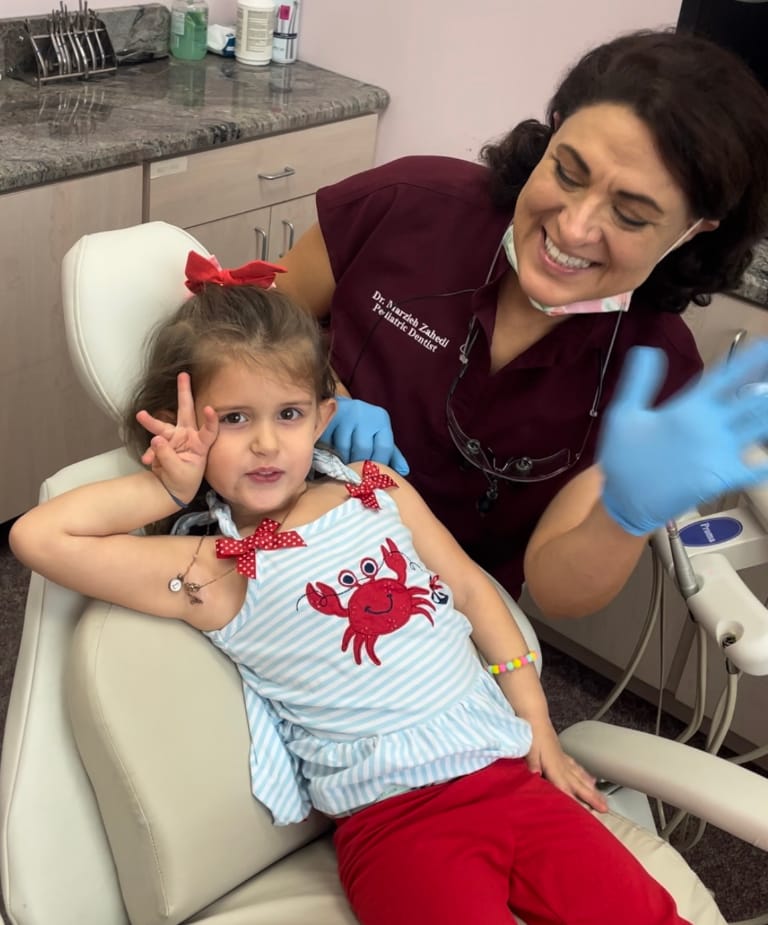
This is the most common form of antianxiety agent we use, with a reliable success rate.
The calming inhalant known as laughing gas is for patients who are mildly or moderately anxious or nervous. It eases their anxieties so that they can relax and undergo treatment comfortably and safely. The gas is administered by placing a small hood over the patient's nose. As the gas takes effect, the patient becomes relaxed but is still awake and can communicate.
Occasionally nausea and vomiting might happen with this type of sedation. We recommend an empty stomach or only a light meal be consumed two hours before administering nitrous oxide to minimize the chance.
More anxious pediatric patients may need an oral medication that is stronger than nitrous oxide. With oral sedation, the patient may be sleepy but can be aroused and respond to simple commands.
It is very safe if done according to the guidelines set forth and by a qualified pediatric dentist. All of our dental assistants are certified in CPR. When indicated, they will constantly monitor your child with the required monitoring equipment to ensure their safety. In addition, Dr. Zahedi is certified in CPR and Pediatric Advanced Life Support (PALS).
The most common drug used is Midazolam, better known by the trade name Versed. We give this medicine in the office as a sweetened syrup, with rapid onset of 15 to 20 minutes. For a longer procedure, we combine this agent with nitrous oxide.
Sometimes we recommend that your child be put to sleep during a dental procedure for a safe and predictable outcome. This is achieved through IV sedation by our qualified pediatric anesthesiologist. We have been offering this service for many years with excellent safety records and high parent satisfaction.
Our pediatric anesthesiologist will discuss the IV sedation technique in detail and how it can benefit your child on a case-by-case basis.
Whether it is your child's first visit, a routine check-up, or a question that has been on your mind, call us or request an appointment online and we will find a time that works.